
If you’re searching for a marketing strategy for small business, you probably don’t want theory — you want a plan you can follow that actually brings customers in.
The good news is you don’t need a massive budget or a complicated funnel to grow in South Africa. What you need is a simple, repeatable system that does three things really well:
1. Helps the right people find you
2. Helps them trust you quickly
3. Makes it easy for them to contact you and buy
This guide gives you a step-by-step small business marketing strategy you can use whether you’re a service business (most common) or selling products locally.
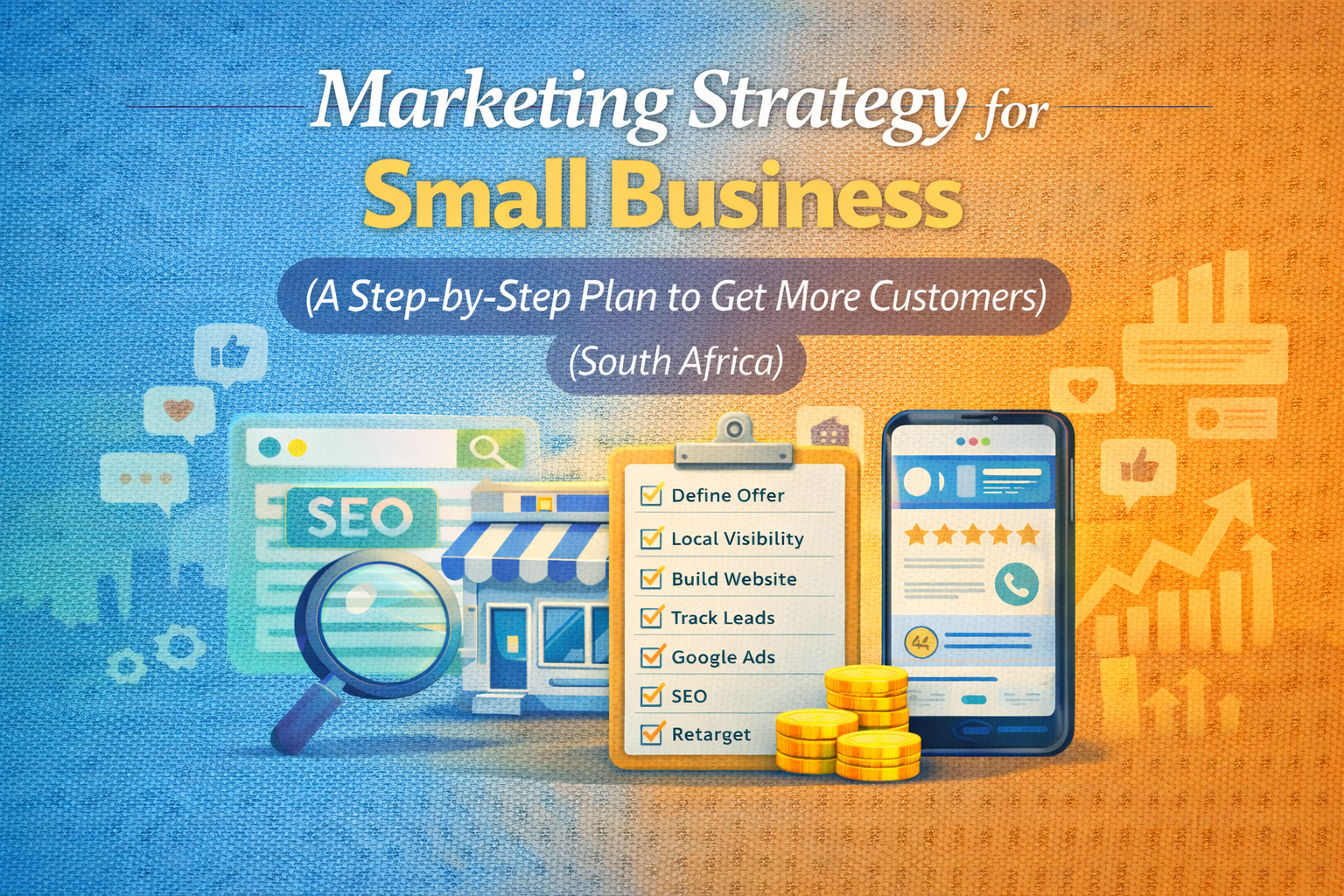
The Step-by-Step Plan Snapshot
This is the one scan-friendly section — then we’ll go deeper.
1. Choose one main offer (and one main customer type)
2. Get your local visibility right (Google Business Profile + reviews)
3. Build a website/landing page that converts
3. Set up lead tracking (calls, WhatsApp, forms)
4. Run a focused “quick leads” channel (Google Ads)
5. Build long-term traffic (SEO + helpful content)
6. Use retargeting to catch “almost customers”
7. Create a follow-up system that wins the lead
8. Review monthly and improve what’s working
That’s your marketing plan for small business in a clear order. Now let’s walk through each step like you’re actually implementing it.
Step 1: Choose One Main Offer (Don’t Market Everything at Once)
Most small businesses lose momentum because they try to market 10 services at the same time.
Start by choosing:
-
your best-selling or highest-margin service/product,
-
the type of customer you want more of,
-
and the area you want to focus on first.
This is the foundation of any small business marketing strategy because it keeps your messaging clear and your budget concentrated.
A simple position statement helps:
“We help [customer] in [area] with [main service] — fast response, clear pricing, professional service.”
Step 2: Fix Your Local Visibility First (This Is Massive in South Africa)
If you serve customers in a city/suburb, this is non-negotiable for small business marketing South Africa.
Your Google Business Profile is often the first impression people get. Before they even reach your website, they’ll see:
-
your rating,
-
your photos,
-
your address/service areas,
-
your phone number,
-
and whether you look active.
Quick wins here:
-
correct categories + services
-
fresh photos (real ones, even from a phone)
-
reviews consistently (a weekly habit)
-
accurate hours + contact buttons
-
WhatsApp where possible
This is one of the most effective small business marketing tips because it’s high intent and often cheaper than ads.
Step 3: Build One “Conversion Page” That Does the Selling
Your website doesn’t need to be fancy. It needs to convert.
Whether it’s a service page or a landing page, it should include:
-
a clear headline (service + location)
-
a short section explaining what you do and who it’s for
-
trust signals (reviews, photos, proof, guarantees, credentials)
-
FAQs (answer what people always ask on WhatsApp)
-
strong CTAs (call, WhatsApp, quote form)
If you’re building a small business marketing guide for yourself, treat this page like your “salesperson that works 24/7.”
Step 4: Set Up Lead Tracking (So You Know What’s Working)
A marketing plan without tracking becomes guesswork.
At minimum, track:
-
phone calls (from website and ads)
-
WhatsApp clicks
-
form submissions
-
which service they asked for
-
what area they’re in
This is where small businesses start winning, because you can stop wasting money and double down on the channels and services that convert.
This step is especially important when you’re running digital marketing strategies for small businesses — because digital is only powerful when you can measure it.
Step 5: Run One Focused Google Ads Campaign for Fast Leads
SEO takes time. Ads can bring leads faster.
But the best approach for small businesses is not “advertise everything.” It’s:
-
one campaign
-
one service
-
one area (or tight radius)
-
one conversion page
-
lead tracking enabled
That’s how you keep it cost-effective and learn quickly.
If the campaign works, you expand to the next service or area. If it doesn’t, you adjust and retest. That’s a real marketing plan for small business, not gambling.
Step 6: Build Long-Term Leads With SEO (So You’re Not Paying Per Click Forever)
Now you build stability.
SEO helps you show up for searches like:
-
“near me”
-
“in [city/suburb]”
-
“cost of [service]”
-
“best [service]”
-
“how to…” questions that lead into your service
The simplest SEO plan for a small business is:
-
strong service pages
-
local SEO (Google profile + reviews)
-
a few helpful posts that support the main services (pricing, comparisons, FAQs)
This is one of the most reliable digital marketing strategies for small businesses because it compounds over time.
Step 7: Use Retargeting to Capture the “Almost Customer”
Most people won’t contact you on the first visit. They compare. They ask someone. They forget. They come back later.
Retargeting ads (to people who visited your site) are often cheaper than cold ads and can lift conversions significantly.
You don’t need fancy creatives — you just need a reminder:
-
“Still need [service] in [area]? Contact us for a quote.”
-
“Fast response. Trusted locally. WhatsApp us now.”
Step 8: Build a Follow-Up System (This Is Where Most Money Is Lost)
In South Africa, people often message multiple businesses at once. The one that responds first and clearly often wins.
A simple lead-handling system:
-
respond fast (even if it’s a short “Got it — sending a quote shortly”)
-
ask 2–3 key questions (area, urgency, details)
-
offer the next step (call-back, booking, quote time)
This alone can increase conversions without spending a cent more on marketing.
Step 9: Review Monthly and Improve What’s Working
This is what turns marketing into growth.
Every month, look at:
-
which channel brought the most leads (Maps, SEO, ads, referrals)
-
which service converted best
-
what areas are producing the best customers
-
where leads are dropping off (slow response, weak page, unclear pricing)
Then do more of what’s working and cut what’s not.
That’s a living small business marketing strategy, not a document that sits in a drawer.
Final Thoughts: A Practical Marketing Strategy for Small Business (South Africa)
If you want more customers, your marketing doesn’t need to be complicated. It needs to be focused and consistent:
-
one clear offer
-
strong local visibility
-
one page that converts
-
tracking
-
one quick-leads channel (ads)
-
one long-term channel (SEO)
-
retargeting
-
fast follow-up
-
monthly improvement
That’s how small business marketing South Africa becomes predictable.