
If you’re asking “how long does seo take”, you’re really asking two things: how long until I see movement… and how long until I see leads.
The honest answer: some SEO changes can show an effect in days, but meaningful results often take weeks to months, especially in competitive South African cities and industries. Google itself says some changes may take effect quickly, while others can take several months to be reflected in Search.
And that’s normal — SEO is compounding. You’re building relevance, trust, and consistency, not flipping a switch.
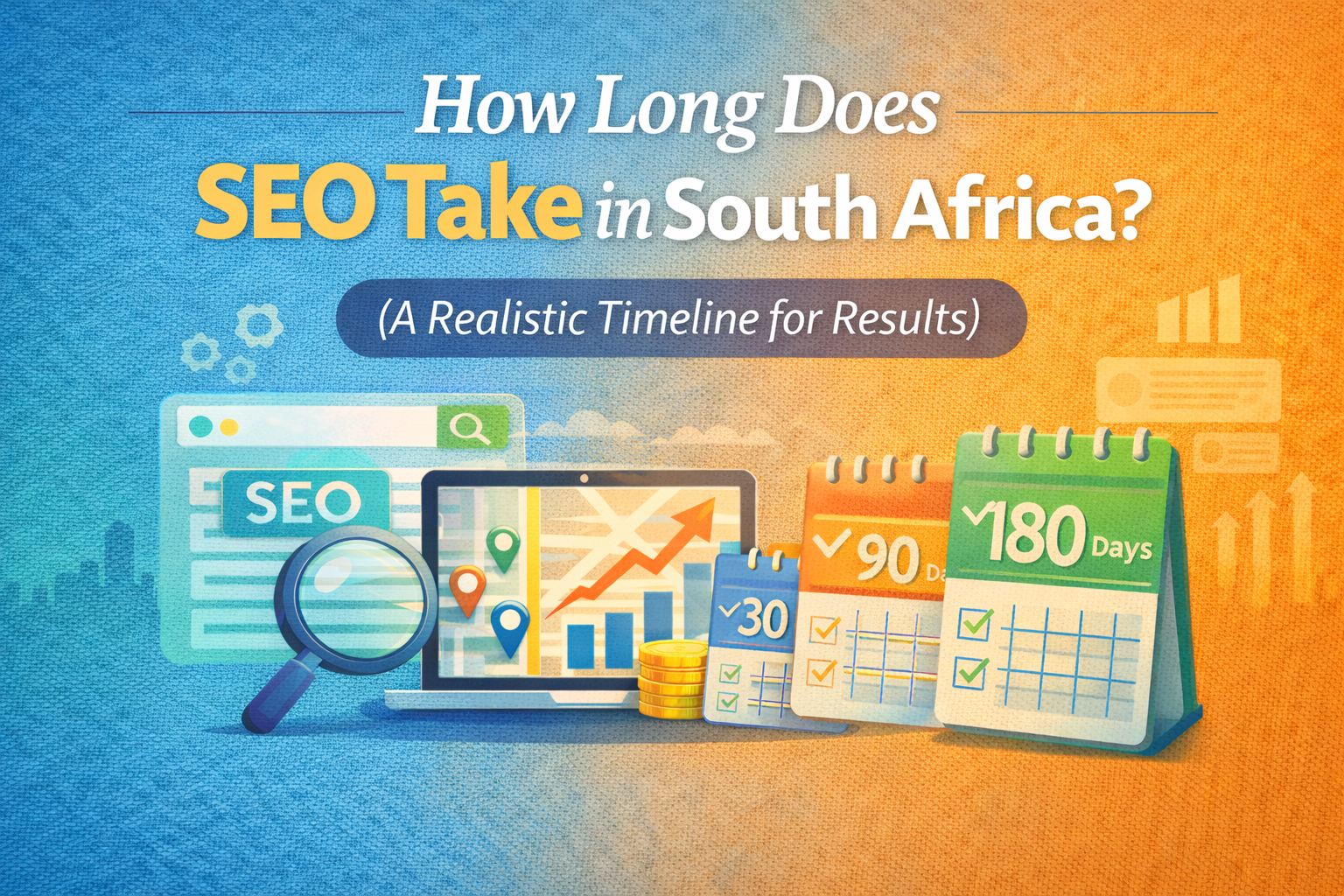
The SEO Timeline Snapshot (30, 90, 180 Days)
This is the one scan-friendly section.
-
30 days: technical fixes + indexing improvements + early movement (more impressions, a few keyword jumps, better crawling).
-
90 days: noticeable traction for realistic keywords; more consistent rankings; early lead flow for some businesses (especially local SEO).
-
180 days: stronger visibility and stability; “SEO starts paying off” phase for many businesses; bigger gains if content + on-page work has been consistent.
Now let’s make that practical—what actually happens at each stage and what you should look for.
First: How Long Do SEO Changes Take to Show?
This is where people get confused. There’s a difference between:
1. Google recrawling and updating your page in the index, and
2. Your rankings improving because Google trusts your site more.
Crawling and processing can take days to weeks (and sometimes longer), depending on your site and how often Google revisits it. Google notes that crawling can take anywhere from a few days to a few weeks, and in other guidance reminds that recrawling can vary widely.
But rankings? Rankings often take longer because Google needs enough signals over time to be confident the improvements are real and consistent. Google’s own guidance is clear: some changes can take a few days, while others can take several months.
30 Days: What You Can Realistically Expect
In the first month, SEO is mostly about cleaning up what’s holding you back and getting your site into a state where it can actually compete.
If your website has technical issues (slow pages, broken links, indexing problems, poor mobile experience), you can see improvement fairly quickly—mostly in crawl behaviour and early ranking movement. Google’s SEO Starter Guide even suggests waiting a few weeks to assess whether work had beneficial effects in Search results.
What “progress” looks like at 30 days:
-
More pages correctly indexed (or fewer “Excluded” problems in Search Console)
-
Impressions rising (you’re being shown more often)
-
Some long-tail keywords moving up (especially low competition)
-
Better conversion performance if you improved CTAs, page speed, and content clarity
In South Africa, local businesses sometimes get early wins faster if the focus is local SEO basics (Google Business Profile optimisation + service page improvements) and the suburb/city competition isn’t brutal.
90 Days: When SEO Starts Feeling Real
If you’re doing consistent work (on-page improvements + content + internal links + local signals), 90 days is often where you start seeing “real” traction.
Many reputable sources describe early meaningful SEO results commonly appearing around 3–6 months, depending on competition and site condition.
At 90 days, you’ll often see:
-
More keywords in the top 20 and top 10
-
Important pages moving steadily upward (not just random terms)
-
Better “near me” / suburb visibility if local SEO is part of the plan
-
A few consistent leads starting to come in (for some businesses)
One helpful mindset: at 90 days, SEO is usually proving direction (the site is trending the right way), even if it’s not fully delivering “peak” lead volume yet. Search Engine Land notes that SEO results can take up to around three months to work through ranking transitions, and longer to fully settle—especially for new sites.
180 Days: Where Results Become More Stable (And Compounding)
By 180 days (about 6 months), SEO often becomes more predictable—assuming you’ve been consistent and you’re targeting realistic keywords.
This is where:
-
pages start “holding” rankings better,
-
more service + location keywords begin to stack,
-
your site builds topical authority (Google sees you as more credible),
-
and lead flow is more stable than the early months.
Google also points out that some improvements—especially those related to broader quality and helpfulness—can take several months, and in some cases you may only see bigger shifts after broader system updates.
This is why many businesses who stop at month 2–3 feel like “SEO doesn’t work”—they quit right before the compounding effect kicks in.
How Long Does SEO Take in South Africa Specifically?
The fundamentals are the same globally, but in South Africa the timeline is often influenced by:
-
How competitive your city/suburb is (Cape Town and Johannesburg suburbs can be tough in popular services)
-
How quickly you respond to leads (fast WhatsApp/call responses turn “SEO traffic” into real ROI)
-
Whether your website is actually built to convert (clear service pages, trust signals, forms, click-to-call)
-
How much content you truly need (some niches need depth; others just need strong service pages + local SEO)
In many SA service industries, local SEO + strong service pages can start producing earlier than “national SEO” because the intent is high and the query is specific (“in Sandton”, “near me”, “in Durbanville”).
How Long Does It Take to Rank on Google?
This depends on the keyword.
If you’re trying to rank for something broad and competitive (like “law firm South Africa” or “SEO agency”), expect longer.
If you’re targeting specific, high-intent searches (“pool leak detection Cape Town”, “accountant for small business Pretoria”), you can often see meaningful movement sooner because the competition is narrower and the intent is clearer.
A good SEO plan mixes:
-
quick-win targets (long-tail, local intent), and
-
long-term targets (bigger, more competitive keywords).
That’s how you get leads while still building long-term authority.
Final Takeaway
So, how long does SEO take to see results? In practice:
-
You can see signals of progress in 30 days
-
You often see noticeable traction around 90 days
-
You typically see more stable, compounding results around 180 days
And Google’s own guidance supports the reality that some changes show quickly, while others can take several months to fully reflect in Search.